

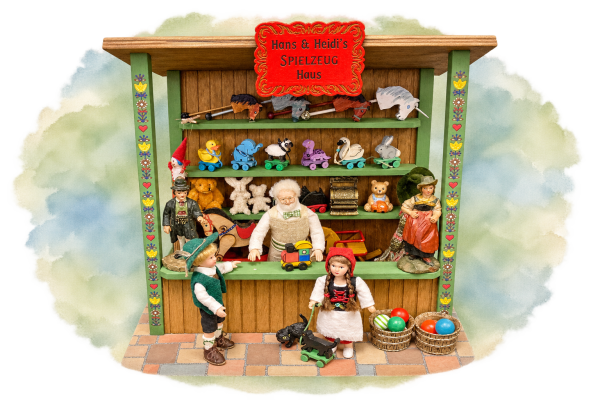
 German Market Stall by Adrien.
Look at how small the toys are next to the shoppers. They’re miniatures within a miniature scene
MCC Resources · Getting started
Small Scale.
A World Of Possibilities.
We hope this friendly guide helps you make sense of miniature scales. Use the calculator to turn full-size measurements into miniature sizes that fit your project.
What does “scale” mean?
Scale describes how much an object has been reduced from its full size. It gives the furniture, people, buildings, and little details in a scene a shared sense of proportion.
In 1:12 scale, every measurement is one-twelfth of the real thing. A real 12-inch length becomes 1 inch in miniature. A 36-inch table becomes 3 inches long.
A few scales you’ll encounter
| Scale | Often called | 1 real foot becomes | A 6-foot object becomes |
|---|---|---|---|
| 1:6 | Play scale (Barbie scale) | 2 inches | 12 inches |
| 1:12 | One-inch scale | 1 inch | 6 inches |
| 1:24 | Half-inch scale | ½ inch | 3 inches |
| 1:48 | Quarter-inch scale | ¼ inch | 1½ inches |
| 1:144 | Dollhouse-for-a-dollhouse scale | ¹⁄₁₂ inch | ½ inch |
The names “one-inch,” “half-inch,” and “quarter-inch” describe how much miniature length represents one full-size foot.

Finding a scale you enjoy
Start with what you love
A favorite kit, doll, or piece of furniture can be your starting point. Check its stated scale before choosing the rest of the scene.
Think about space and comfort
Smaller scales let a project fit into less room. Larger pieces may be easier to handle, paint, and furnish. Choose what feels comfortable for your hands and eyes.
Check the measurements
“Miniature” alone doesn’t tell you the scale. Look at an item’s dimensions as well as its photos, especially when combining vintage pieces or decorative collectibles.
A little math makes everything fit
For a 36-inch table at 1:12, divide 36 by 12: the miniature table is 3 inches long. At 1:48, that same table is ¾ inch long.
Already working in miniature? To change a 3-inch piece from 1:12 to 1:24, multiply by 12 and divide by 24. The new length is 1½ inches.
Use matching units for a hand calculation. The converter below can also change units for you.
Scale Converter
Enter the measurement you have, choose its current scale, and select the scale you want. Use Real life (1:1) for a full-size measurement. Open each dropdown to see its available units or scales.
Before you cut or buy
Measure the space in your project and compare a few related pieces. A table, its chairs, and the doorway should make sense together. When printing a pattern, check its test square or ruler and print at the intended size rather than “fit to page.”
Exact matching is useful for a realistic scene, but imaginative projects can mix scales on purpose. Let the measurements support the story you want to tell.
Explore a Little Further
These resources offer more examples of scale in miniatures, model railroads, and dioramas.
- The National Museum of Toys and Miniatures: All About Scale
- Miniature Museum of St. Louis: miniature scales in its collections
- The Miniature Society of Cincinnati: About Miniature Scales
- National Model Railroad Association’s guide to model train scales and gauges
- Diorao’s guide to common diorama scales